Welcome to our page of
Early American Literature
with focus on
 Native American
oral traditions
Native American
oral traditions
Short
introductions to the topics and authors represented on this page are
accompanied by recordings of samples of
the texts by native speakers.

Native
American
Oral
Traditions
A look at Native American traditions from
three different points of view.
The first text ” Wohpe and the Gift of the Pipe”
is a Lakota creation Myth. Wohpe is feminine and the mediator between earth and
sky, also referred to as one of the wakan tanka, one of sixteen aspects of the Great
Spirit. She is recognized in nature as the meteor or falling star. The Pipe is
one of seven principal rites of the Lakota. The narrative was written down by James R. Walker, a
physician to the Oglala in March 1914. It was told to him by Finger, an old and
very conservative Oglala holy man.
The second text from ”The Generall Historie of
Virginia, New-England, and the Summer Isles” was written by John Smith, an English
settler in the Jamestown colony. In “Smith as
captive at the court of Powhatan in 1608” he describes Native Americans
from the colonial point of view. He was captured by Algonkians and narrates his
experiences with the Indians and how his life was saved by Pocahontas, the
daughter of Powhatan.
The third text is again a creation myth. ”Creation
of the Whites” by the Yuchi. The Yuchi originally inhabited the
south-eastern Appalachian mountains but later moved south-eastern into the
lowlands. The tale is an example of how the natives tried to explain the
approach of the White People.
James W. Walker
was a physician to
the Oglala at the Pine Ridge Reservation from 1896 to 1914. He sought the assistance
of the medicine men to help him understand and serve the Lakotas. They began to
teach him the stories and ceremonies of the Lakotas, stating, ”We will do this
so you may know how to be a medicine man for the people... We will tell you of
the ceremonies as if you were an Oglala who wished to take part in them.
”Finger, an old and very conservative Oglala holy man who was very helpful in
enabling Walker to understand some of the most complex Oglala beliefs, told
this story on March 25,1914, in response to Walker’s enquiries about how the
pipe came to the Lakotas. The story was published in 1980.
John Smith (1580-1631) Born in Lincolnshire John
Smith led an adventurous life as a soldier, fighting in Europe against the
Turks before getting interested in the British colonies. He went to Virginia as
a councillor to the first settlers in 1606. He was very successful in
organizing life and survival in the young colony and became president in 1608.
In 1609 the Virginia Company decided to reorganize the colony and Smith was
replaced. He returned to England and promoted strongly colonization. To serve
this purpose he wrote several books, among them the above quoted. His captivity
narration and the role of Pocahontas grew to be one of the myths of the new
colonies
Puritan Heritage

Anne Bradstreet
Anne Dudley Bradstreet
was born in England in 1612. Since her father, Thomas Dudley, was a steward to
the Earl of Sempringham, she had the opportunity to use the Earl’s library. So
for a woman of her time, she received a good education.In 1628 she married
Simon Bradstreet, who was a Nonconformist like his wife. Together with her
parents she and he moved to Massachusetts in 1630. Due to the fact that she and
her family belonged to the Puritans, they strongly believed that the journey to
the New World was determined by God. Thus Anne Bradstreet joined the puritan
church of Boston.
During
her life she raised eight children and began writing poetry. The first edition
of her poems was published in London in 1650. It was called The Tenth Muse Lately Sprung in America and
it includes lots of criticism of the Renaissance concerning female writers. Her
second edition, which appeared posthumously in 1678, dealt with more private
matters like family, nature, love, sorrow, and the world. An example of these themes is the poem Contemplation. The predestination by God is the central topic of this
work. Furthermore, she tried to show the tensions between her love of the
world, concern for the after-life and Puritan doctrine. Anne Bradstreet died in
North Andover in 1672.
William Bradford
William
Bradford was born in Yorkshire in 1590. He lost his parents and his grandfather
early in life and thus he grew up with his uncles. They made him become a
farmer, but since he wasn’t very healthy, he had the opportunity to read a lot
in the bible. And through this, his interests in religious themes began in
1602. He listened to the sermons of
Richard, a nonconformist minister. He was so inspired by the pastor’s words
that he became a member of this group called Puritans in 1606. Their aim was to
reform the hierarchy of the Anglican Church, but for this they received a lot
of pressure. Because of that, they fled to Holland in 1608, and later, in 1620,
they sailed with the Mayflower to Massachusetts.
In
1621 Bradford became the spiritual leader of the group. In 1630 he wrote his
first book of his history, Of Plymouth
Plantation.
 Mary White Rowlandson
Mary
White Rowlandson was born in Somerset, England, in 1637. Although we don’t have
much information about her childhood , we know the she emigrated with her parents
to Massachusetts in New England. She married the Reverend Joseph Rowlandson of
Lancaster. They had four children but her first child Mary died after her third
birthday.
In
1675 a war started between, on the one hand, the colonial governments of Plymouth,
in Massachusetts Bay, and Rhode Island and, on the other hand, the Algonkian
Indian tribes. This cruel confrontation also affected Mary Rowlandson’s life
because in 1676 a group of Indians attacked Lancaster. She and her children
were kidnapped and many of her neighbours were killed. One year later in 1677
she was able to get free and settled with her family in Boston.
The
narrative A Narrative of the Captivity
and Restauration of Mrs Mary Rowlandson deals with these experiences. It
includes a discourse of national rights and God’s challenge to the nation. It
became one of the first best-sellers in American Literature.
After
the death of her first husband in 1679 Mary Rowlandson married Captain Samuel
Talcott, a member of the War Council during the King Philip’s War. He died in
1691. After his death she didn’t marry again and died in 1711.
Enlightenment
Benjamin Franklin – The Autobiography
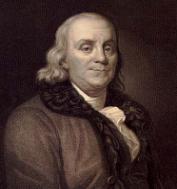 The life of
Benjamin Franklin is often associated with the Declaration of Independence. But he wasn’t just a member of the founding fathers, he was more. He
also became famous for being a scientist, an inventor, a statesman, a printer,
a philosopher, a musician, and an economist. Today, Benjamin Franklin is still
honored as one of America’s greatest citizens. He “in each of his many careers,
…provided the prototype for special qualities that in his own day and ever
since have been regarded as characteristically American” (Encarta Americana).
The life of
Benjamin Franklin is often associated with the Declaration of Independence. But he wasn’t just a member of the founding fathers, he was more. He
also became famous for being a scientist, an inventor, a statesman, a printer,
a philosopher, a musician, and an economist. Today, Benjamin Franklin is still
honored as one of America’s greatest citizens. He “in each of his many careers,
…provided the prototype for special qualities that in his own day and ever
since have been regarded as characteristically American” (Encarta Americana).
Born
in Boston, Massachusetts on January 17, 1706 to Josiah and Abdiah Franklin, he
was the 8th of 10 children. His father had 7 other children by his first
wife, so 17 in all and there is reference in the autobiography to his remembering times where 13 sat together at the dinner table.
At
the age of 8, Benjamin was sent to grammar school where he excelled as a good
student. He learned to read quickly and even finished 2 school years in one
year. Nevertheless, Benjamin was removed from the grammar school and sent to a
school for writing and arithmetic, because for his father the expense was too
great for the economic prospects of such a vocation. In 1716, now ten years
old, he was again removed from school and began to work with his father who was
a candle and soap maker. Although Benjamin had “a strong inclination for the sea”,
his father didn’t want him to go there and therefore searched for another trade
for him and eventually placed him in his brother’s printing shop in Boston
where he was apprenticed until the age of 17. There he developed to become a
talented printer and even contributed to his brother’s New England Courant his Dogood Papers. After a quarrel with
his brother James, he ran off to Philadelphia where he entered the printing
shop of Samuel Keimer. There he further honed his literary skills during his
struggles to succeed in business, to advance philanthropic projects, and to
forward his views on political and controversial issues.
Under the patronage of
Governor Keith, who offered to set Benjamin up as a printer, he sailed to
England in 1724 to buy equipment for his own press. At his arrival he
discovered that the governor’s promise was empty and as a result he failed to
receive the money. Benjamin Franklin stayed in London though, where he
continued his training as a printer for the next 18 months. In 1726 he returned
to Philadelphia where he first worked for a merchant he had met on his journey
and later in the printer’s shop he had used to work in before he had gone to
England. When Benjamin was 22 years old, he opened his own printer’s shop. This
new business was a success due to Benjamin’s hard work, skill and diligence. In
1729 he acquired the Pennsylvania Gazette
from his former employer, who was unable to make a go of it. Benjamin turned
this newspaper into a great success, in part because of his wit and
intelligence in writing and editing, but also because of the use of pictures,
to enable those who couldn’t read to understand the news.
One year later he
married Deborah Read Rogers, his teenage love, with whose family he had boarded
when he first came to Philadelphia at the age of 17. They had three children,
William, Francis, and Sarah.
In his pragmatic way,
he devised at 22 a “religion” for the attainment of useful virtues, holding
firmly to the belief that the most acceptable service to God is doing good to
men. When he had kept his shop so well that it kept him, he became a leader in
philanthropic, scientific, and political affairs. He initiated projects for
establishing city police, for paving, cleaning, and lightning the streets, and
for the first circulating library. He also founded the American Philosophical
Society, a city hospital, and an Academy for the Education of Youth, which was
the forerunner of the University of Pennsylvania. His interest in every sort of
natural phenomenon led him to his famous kite experiment to show the identity
of lightning and electricity (reported in his book Experiments and
Observations on Electricity, 1751).
In 1757 he was sent to
England to attempt to secure better governmental conditions for the colony
where he stayed until 1775. During that time he started to write the first
section of his autobiography. His
connection with the Thomas Hutchinson letters led to his dismissal from
England. Discouraged by the British attitude towards Americans and disappointed
by the extreme corruption in England, he discarded his loyalties to Britain, no
longer supported a united empire, and returned to America in 1775 as an American
and not a Brit living on American soil. There he was elected to the Continental
Congress and submitted the Articles of Confederation of United Colonies. The
following year he signed the Declaration
of Independence and began serving as commissioner to France. There
he succeeded in securing a treaty of commerce and defensive alliance (Feb.
1778). In 1782 he negotiated the treaty with England and two years later with
other European countries. In 1785 he returned to the USA and in 1787 he was
elected President of the Pennsylvania Society for Promoting the Abolition of
Slavery. During that time he also served as a delegate to the Constitutional
Convention.
On April 17, 1790
Benjamin Franklin passed away at the age of 84.
The Autobiography of Benjamin Franklin’s life was first never meant
to be published. He wrote the first part of it during his stay in England in
1771 as a letter to his son William. It took him until 1789 though to finish
his whole work. His autobiography can be divided into three sections. The first
section tells the story of his youth in his home- town Boston as well as in Philadelphia
where he went to at the age of 17. Through the eyes of a tolerant elderly
narrator, the reader watches the young Franklin learn through experience the
necessity of virtue, work, and shrewdness in dealing with the world. Although
the young Benjamin Franklin possesses numerous faults, he eventually succeeds
because of his talent, industry, and capacity for learning from his errors.
In the second section
of his autobiography Benjamin Franklin tries to achieve moral perfection. Here
a bridge is drawn between his youth and his adulthood, pointing out the
principles he learned through experience were necessary for happiness and
success.
The last section
portrays Franklin’s use of the principles he set up in former times. This part
focuses on his rise of prosperity, his scientific studies, and especially on
his work as philanthropist and politician. The reader is occasionally reminded
that human folly can never be eradicated.

John
Adams is known as the first vice president of the USA and the second president.
He was not the only family member involved into politics. His son, John Quincy
Adams, was president as well and his grandson, Charles Francis Adams, was
minister to Britain during the Civil War.
He
was born on October 30, 1735 in Braintree (now Quincy), Massachusetts. In 1751
he entered Harvard College where he graduated four years later with a Bachelor
of Arts degree. He first worked as a schoolmaster in Worcester but soon was
looking to escape the humdrum life of a schoolmaster and began to study law. He
was admitted to the bar in 1758.
In
1764 he married Abigail Smith with whom he had five children.
In
his resistance against English superiority in the Colonies he opposed the Stamp
Act and the Boston Port Act. John Adams was also a member of the first
Continental Congress, where he aided in drafting a petition to the king and a
declaration of rights. In 1765 he published his “Dissertation on the Canon and
the Feudal Law” in which he warned against British attempts to impose English
law on the colonies as part of an effort to subvert American liberties.
From
1777-1779 he was a commissioner to France, one year later he became minister to
the Netherlands and was minister to England in 1785. After serving two terms as
vice president (1789-97) he was elected to the presidency in 1796.
As
a constant writer of diary entries, legal notes, forceful replies to
adversaries etc., his most important ones are the letters to his wife Abigail
and to Thomas Jefferson. Repairing the breach in their
friendship that stemmed from the election of 1800, Adams and Jefferson carried
on a lively discussion about literature, history, and social ideals. Their discussion
about an aristocracy of talent and virtue, for example, raised important
questions about individuals in a democratic society.
John
Adams died on July 4, 1826.
Female Authors
 Judith Sargent Murray
Judith
Sargent Murray’s writing career started in the 1790’s when America tried to
define itself as an independent country. She concentrated on topics like
women’s equality, religious universalism, literary nationalism, and the federal
system of the government. The reason for focusing on these themes was her good
education when she was a child. Judith Sargent Murray was born in Gloucester,
Massachusetts, as the oldest child of Captain Winthrop Sargent and Judith
Saunders. Her high degree of intelligence was soon discovered and, thus, she
was able to study Greek and Latin, literature, and sciences including
mathematics and astronomy. At the age of eighteen she married John Stevens, a
sea captain.
Although having published many books, The Equality of the Sexes was the most influential one. It
criticised the fact that women were viewed as not equal to men. She directly
said that housework, for example, was mindless work which denies opportunities
to women’s intelligence.
Furthermore,
she stressed the importance of an equal development in education because only
then were women able to develop their intelligence and judgment. Even their
souls were equal because they were equal in the eyes of God.
Murray
herself followed this suggested system because she established herself as an
independent writer and died in 1820.
Verses Written by a Young
Lady
During
colonial times many newspapers published anonymous or pseudonymous poems. They
were widely read in British and North America, and they show the public
interests of people in that time.
One
example is the poem Verses Written by a
Young Lady, on Women Born to Be Controll’d. It is about the equality of
sexes. No woman at that time was free to decide what her personal fortune would
be. Fathers and brothers kept an eye on them in order to control what kind of
man they met, for example. In this poem, women’s roles were compared to those
of slaves.
Letter from
Abigail to John Adams
Abigail
Smith, who was born in 1744, was educated by her grandmother and she married
John Adams in 1764. He became the first vice president of the United States.
Abigail Adams accompanied her husband on diplomatic missions and influenced his
political ideas with her Federalist view. Therefore it is obvious that the marriage
of these two combined two strong minds. Abigail was never afraid of telling her
opinion to her husband. As a consequence she wrote a letter to her husband that
stressed the importance of change concerning the consciousness of women during
and after the revolution.
Voices of Black
America
The two authors represented on this page were both
born in Africa and brought to the colonies as slaves. They were sold to good masters,
and had there for the chance to learn to write and read and to lead a
comparatively comfortable life. They lack the experience of life and work of
the slaves on the plantations of the south.

Thomas
Jefferson, most remembered as one of the founding fathers, served his country for
over five decades as a public official, historian, philosopher, and plantation
owner. Born
on April 13, 1743 in Shadwell, Virginia he grew up in a very distinguished and
prominent Virginia family. At the age of 21 he inherited a considerable land
estate on which he began building Monticello (his residence house) five years
later. As a wealthy man he occasionally owned over 200 slaves. In
1772 he married Martha Wayles Skelton with whom he had three children but only
two of them survived to adulthood. His wife passed away in 1782. Having
attended the College of William and Mary, Jefferson practiced law and served in
the local government as magistrate, county lieutenant, and member of the House
of Burgess. In 1775 he was elected to the Continental Congress to draft the Declaration
of Independence. One year later he left Congress and returned to
Virginia where he was elected to the Virginia House of Delegates. While being
Governor of Virginia (1779-1781) he started writing his Notes on the State
of Virginia. From
1784-1789 he lived in France where he first served as a Commissioner and later
as Minister. During his time in France he finished and published his Notes
on the State of Virginia. In
1790 he accepted the post of Secretary of State under his friend George
Washington. His opposition to the pro-British policies of Alexander Hamilton
marked his tenure. As the presidential candidate of the Republicans in 1796, he
became vice-president after losing to John Adams by three electoral votes. Four
years later he became president himself by defeating John Adams, the first
peaceful transfer of authority from one party to another in the history of the
young nation. During his presidency he concluded the Louisiana Purchase (1803)
and supported the Lewis and Clark expedition while during his second term, a
time of difficulties both on domestic and foreign fronts, he mainly tried to
maintain neutrality in the midst of the conflict between Britain and France. In
1809 he retired from presidency and public life and remained at Monticello for
the rest of his life. Six
years later in 1815 he sold his 6,700-volume library to Congress, which formed
the cornerstone of the Library of Congress. At the age of 76 he performed his
last great public service and founded the University of Virginia. Thomas
Jefferson died on July 4, 1826. A Declaration by the Representatives of the United States
of America, in General Congress Assembled (Declaration of Independence): The first patriot and loyalist songs and ballads were written in the
years of the Revolutionary War. The stirrings of men’s hearts, the expression
of their hopes, desires, and motives, inspired many songs and ballads during
that time. The songs were not only written by ordinary people but also by well
known literary or political figures like Benjamin
Franklin, Thomas Paine, Philip Freneau, and Joel Barlow. Most popular songs and ballads of that time reflect the hearts
and the minds of the people back then. In all there existed more patriot
(pro-American) than loyalist (pro- English) songs, simply because the loyalist
writers started later than the patriot writers. In fact, the loyalist response
was less appealing and exciting because it was largely defensive and based on
traditional values and structures. Both sides tried to persuade the American
public that their side was winning and that the opponents’ victories were
spurious, that their military leaders were brilliant while their opponents’
military leaders were fools, that they were fighting fairly and courageously
while their opponents were savage and cruel. The loyalists often emphasized the
illegality of the revolution, the loss of English honor, truth, and loyalty as
well as the advantages of union with England. The patriots on the other hand
emphasized English politics, the tyranny and corruption of the English
parliament, and the need to preserve the idea of the forefathers. The songs and ballads were spread by pamphlets, newspapers, or
word-of-mouth among citizens and soldiers. Examples of both a patriot and a
loyalist song can be found below. Joel Barlow was born as the second-to-last child in a large
family of a well-to-do farmer in Redding, Connecticut in 1754. After receiving
formal education from the local minister he attended Dartmouth College. His
father’s death made it necessary for him to return home where he transferred to
Yale College. The
Revolutionary War interrupted his college years so that he served as chaplain
for the Third Massachusetts Brigade. After the war he continued his studies at Yale,
where he became a member of the Connecticut Wits, with whose orthodox Calvinism
and aristocratic politics he sympathized. After getting a degree in law he was
admitted to the bar in 1786. His
epic poem about North and South American progress “The Vision of Columbus”
was published in 1787. Two years later he sailed to Europe where he stayed for
the next 17 years. During his residence abroad he changed from a conservative
Connecticut Puritan to a cosmopolitan democrat. As a reward for “A Letter to
the National Convention of France” he was awarded French citizenship. In
1796 he published his renowned “The Hasty Pudding” for which he is best
remembered. It is a mock epic in three cantos, which celebrates a native
American dish as well as “simplicity of diet”. It additionally considered the
poet’s rendering of his boyhood. By 1805 Joel Barlow and his wife Ruth
Baldwin, who he had married in 1781, returned to the USA and established
themselves in the Washington community. Only 6 years later he was called upon
diplomacy again by President Madison, who sent him to France again to negotiate
a treaty under which France would accord American goods favor and pay
compensation for affronts against neutral U.S. ships in European waters. Joel
Barlow died chasing the defeated and retreating Napoleon in Poland in 1812. Reference: Paul Lauter ed.
(1999)-Heath Anthology of American Literature. Boston. Houghton Mifflin The following texts have been recorded and are available
on CD. They are sold in the English Department’s records office. Texts by Mark, Niels, and
Susanne Recording by Kimberly,
Stacy, Jason, Michael, and Wolfgang Design of Page by Susanne Your comments or ideas
concerning this page are appreciated. February 2002

Traces of The
American Dream
 On June 7, 1776,
Congress, meeting in Philadelphia, received Richard Henry Lee's resolution
urging Congress to declare independence. Four days later, on June 11, 1776 Thomas
Jefferson, John Adams, Benjamin
Franklin, Roger Sherman, and Robert Livingston were appointed to a
committee to draft a declaration of independence. Thomas Jefferson did the
actual writing but Benjamin Franklin, John Adams, and Congress at large revised
it. The document is based on the natural rights theory of government, derived
from Locke and 18th-century French philosophers and proclaims that
the function of the government is to guarantee the inalienable rights with
which men are endowed. These rights are Life, Liberty, and the Pursuit of
Happiness. The reasons for proclaiming independence and for justifying that a
revolution was necessary were (are) stated in the document. During the British
supremacy in the former colonies, King George III of Great Britain willfully
violated the inalienable rights that are mentioned in the declaration. On July
4, 1776 Congress adopted the Declaration of Independence.
On June 7, 1776,
Congress, meeting in Philadelphia, received Richard Henry Lee's resolution
urging Congress to declare independence. Four days later, on June 11, 1776 Thomas
Jefferson, John Adams, Benjamin
Franklin, Roger Sherman, and Robert Livingston were appointed to a
committee to draft a declaration of independence. Thomas Jefferson did the
actual writing but Benjamin Franklin, John Adams, and Congress at large revised
it. The document is based on the natural rights theory of government, derived
from Locke and 18th-century French philosophers and proclaims that
the function of the government is to guarantee the inalienable rights with
which men are endowed. These rights are Life, Liberty, and the Pursuit of
Happiness. The reasons for proclaiming independence and for justifying that a
revolution was necessary were (are) stated in the document. During the British
supremacy in the former colonies, King George III of Great Britain willfully
violated the inalienable rights that are mentioned in the declaration. On July
4, 1776 Congress adopted the Declaration of Independence. Patriot and Loyalist Songs and Ballads
Joel Barlow – The Hasty Pudding, A Poem, in Three Cantos